Edgar Dubourg

AI Research Fellow (Paris School of AI, PSL)

PhD in Cognitive Science (ENS-PSL)

I study the motivational building blocks of the human mind (e.g., curiosity, fear, love, humor, sociality), combining theories from evolutionary and cognitive science with AI-based methods and large-scale cultural, behavioral, and psychological data. I look at how these motivations explain both why fiction, games, and stories captivate us and, more recently, why some public messages, in health and beyond, motivate people or fail to.

Download CV
Université PSL Institut Curie ENS-PSL Institut Jean Nicod
Edgar Dubourg

Research

Some people are easily moved to outrage, others to tenderness. Some are pulled toward novelty and curiosity, others toward connection and care. These differences in which motivations grip us most are not random. I study the computational architecture of motivational preferences. In particular, I investigate why these preferences vary across individuals, drawing on personality psychology and behavioral ecology, and how the same high-level motivations can lead to different decisions, building on theories of goal hierarchies.

Not everyone loves the same stories, and these differences are not random. I study how personality and motivation shape preferences for narratives, imaginary worlds, and other cultural products. Using computational methods and large-scale cultural datasets, I trace how individual-level preferences scale up to cultural change across societies and centuries, from ancient myths to modern entertainment.

Curiosity is not a single urge but a family of them, and people differ in how strongly each one pulls at them. I study the psychology of curiosity and openness to experience: what makes some minds reach for novelty, abstraction, and the pleasure of insight, how these dispositions are calibrated by ecological conditions such as safety and resources, and how they shape the cultural tastes and worldviews that follow from them.

Culture can now be measured at a scale that was unthinkable a decade ago. I develop and scrutinize methods that use large language models to annotate massive corpora of text, images, and sound, turning questions once limited by the human eye into tractable empirical problems. I care as much about what these tools make possible as about their limits: when automated annotation can be trusted, and when abundant data quietly turns small errors into false discoveries.

People often know what they should do but don't act on it, a gap that standard public health campaigns fail to close. I apply the same motivational framework to health contexts, developing personalized communication strategies that align messages and treatments with individuals' motivational profiles, with the goal of improving engagement and behavior change.

Findings

A few visual insights from recent papers. Click any figure for the source paper and a short explanation of the data, models, and result.

Publications

Preprints & Submitted

26
Agentic AI as epistemic tools
Dubourg, E., Altay, S.
PsyArXiv · 2026
25
From Players to Participants: Citizen Science and Video Games to Understand Cognition
Salouhou, S., Dubourg, E., Scott-Slade, M., Spiers, H., Coutrot, A.
arXiv · 2026
24
The Double Edge of AI Annotation in Cultural Sciences
Dubourg, E., Thouzeau, V.
Under review
23
Motivational content features improve tailoring of anti-smoking advertisements
Avenel, J., Bidant, E., Pasquereau, A., Guignard, R., Nguyen-Thanh, V., Chevallier, C., Nettle, D., Dubourg, E.
PsyArXiv · 2026
22
Personality structure predicts story preferences across 23 countries
Dubourg, E., Thouzeau, V., Freynet, R., Darcy, G., Beuchot, T., Noël, N., Chevallier, C., Baumard, N.
PsyArXiv · 2026
21
Motivational Alignment, Not Demographic Similarity, Predicts Narrative Interest
Maunoir, P., Chambon, V., Baumard, N., Thouzeau, V., Dubourg, E.
PsyArXiv · 2026
20
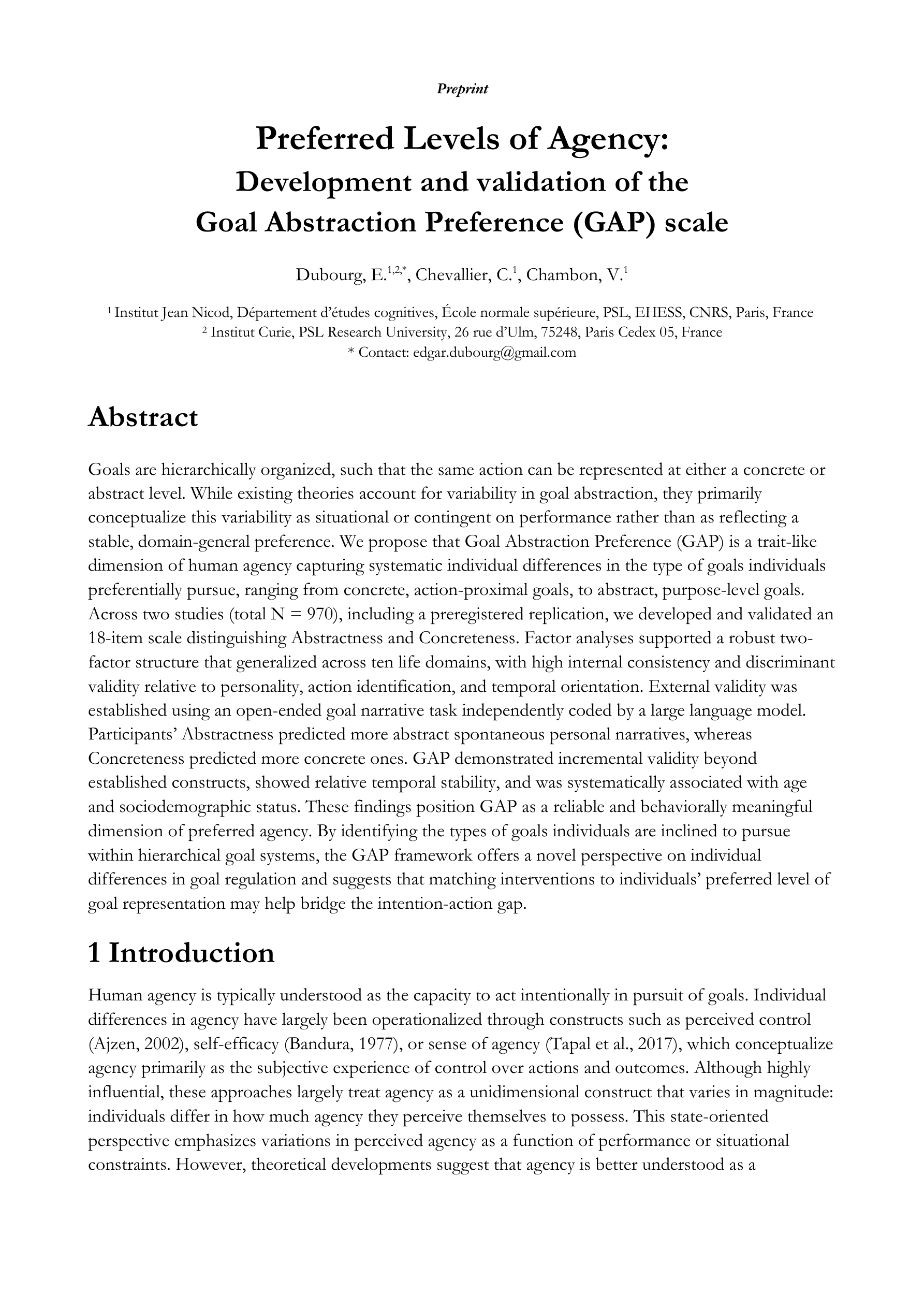
Preferred Levels of Agency: The Development and Validation of the Goal Abstraction Preference (GAP) Scale
Dubourg, E., Chevallier, C., Chambon, V.
PsyArXiv · 2026
19
Cues of benignity explain why some misfortunes are funny
Hye-Knudsen, M., Dubourg, E.
Under review
18
The Rise of the Morally Ambiguous Protagonist
Abdeljaouad, S., Dubourg, E., Baumard, N.
Under review
17
The Paradox of Modern Love: Why Romantic Signals Decline in Developed Societies
Dubourg, E., Lie-Panis, J., Thouzeau, V., Chevallier, C., Kowal, M., Sorokowski, P., Baumard, N.
Under review

Peer-Reviewed Articles

16
Carving Stories at their Natural Joints
Dubourg, E., Thouzeau, V., Beuchot, T., Bonard, C., Boyer, P., Chevallier, C., Clasen, M., Boon-Falleur, M., Fiorio, G., Fitouchi, L., Fisher, M., Gantman, A., Grant, A., Hye-Knudsen, M., Katiyar, T., Kjeldgaard-Christiansen, J., Mercier, M., Mercier, H., Morin, O., Salmon, C., Scott-Phillips, T., Scrivner, C., Sijilmassi, A., Singh, M., Smith, M., Sobchuk, O., Stubbersfield, J., Varnum, M., van Mulukom, V., Verpooten, J., Wylie, J., Zhong, Y., Baumard, N.
Accepted at Psychological Review · 2026
15
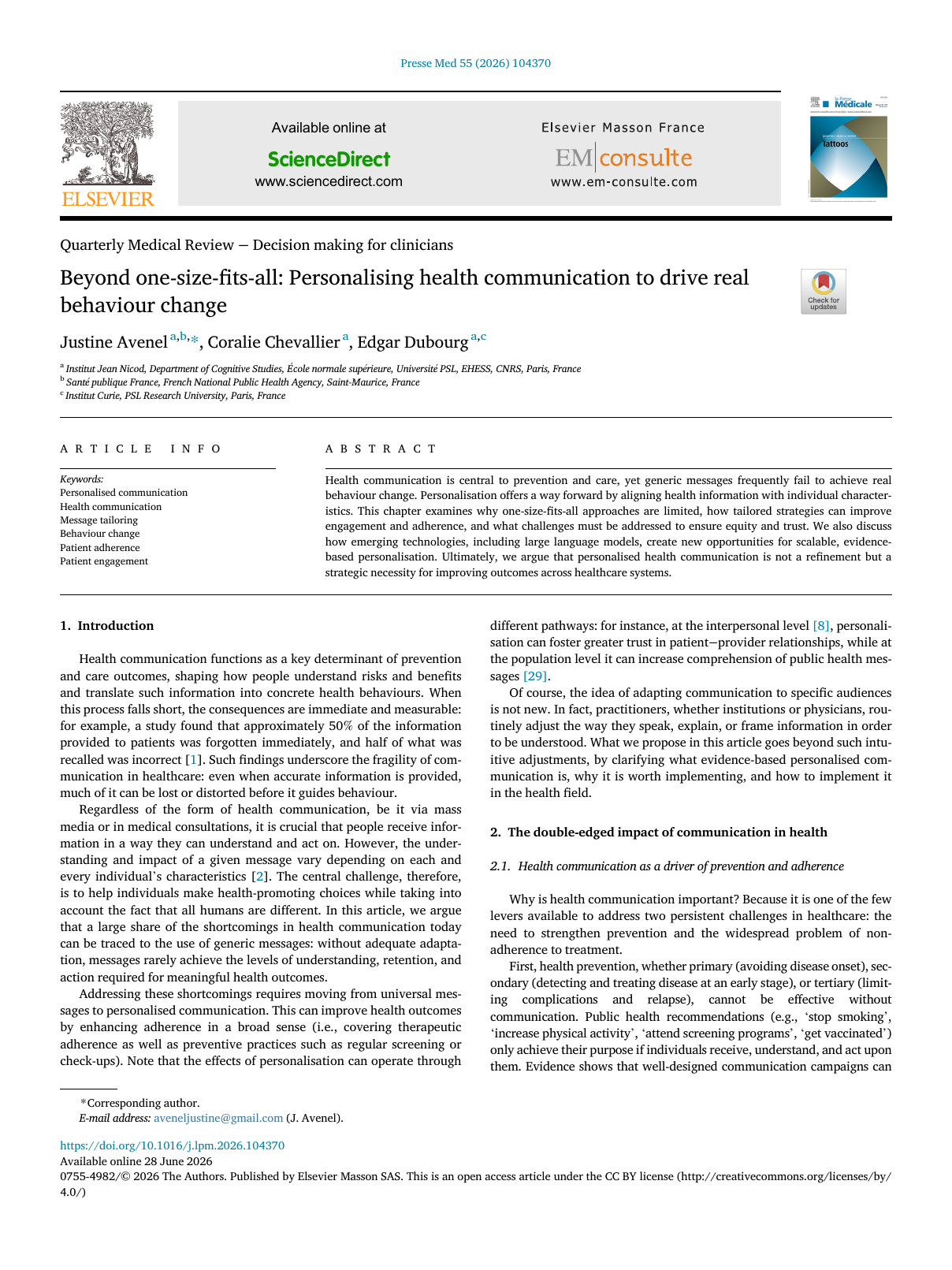
Beyond One-Size-Fits-All: Personalising Health Communication to Drive Real Behaviour Change
Avenel, J., Chevallier, C., Dubourg, E.
Quarterly Medical Review · 2026
14
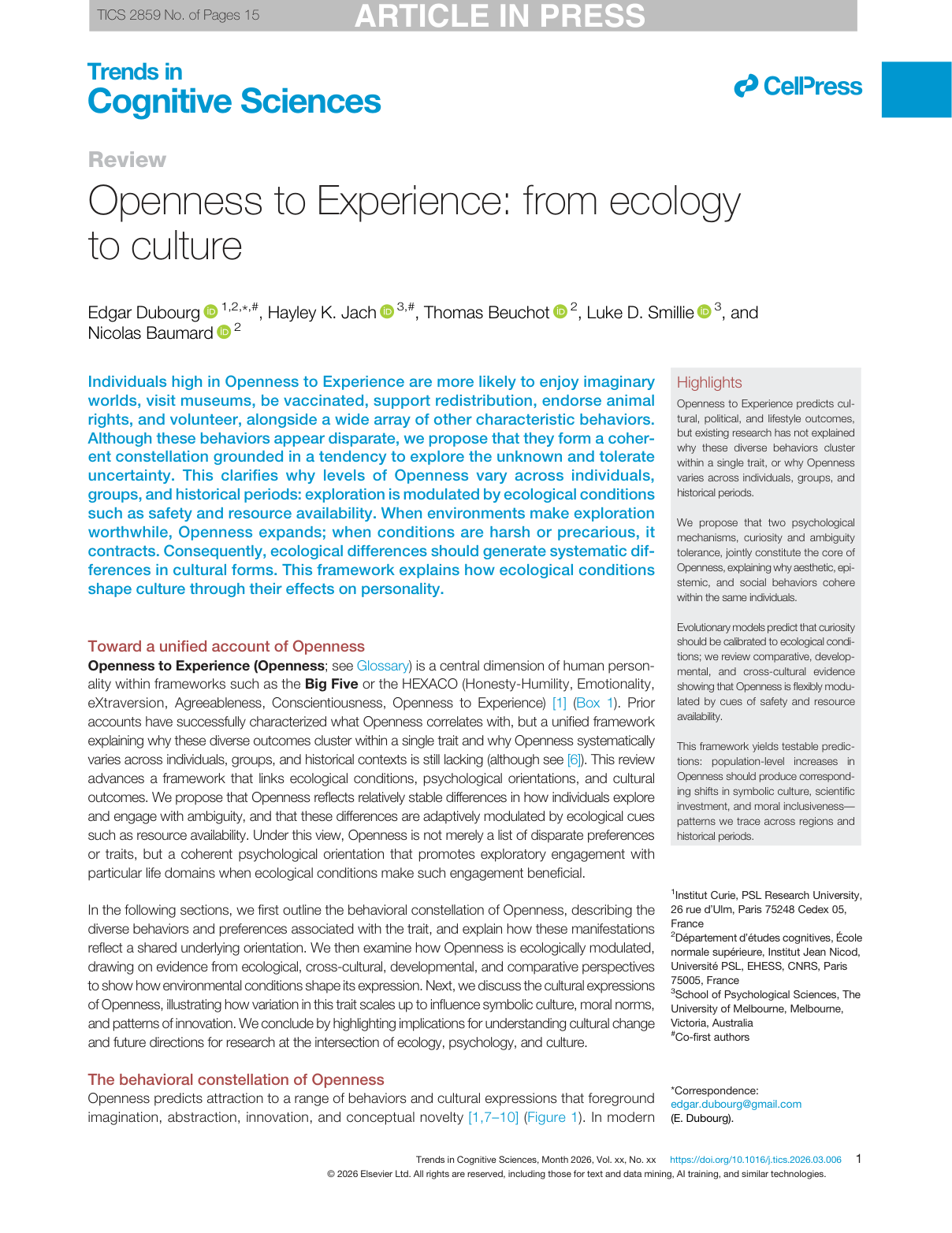
Openness to Experience: From Ecology to Culture
Dubourg, E.*, Jach, H.*, Beuchot, T., Smillie, L., Baumard, N.
Trends in Cognitive Sciences · 2026
13
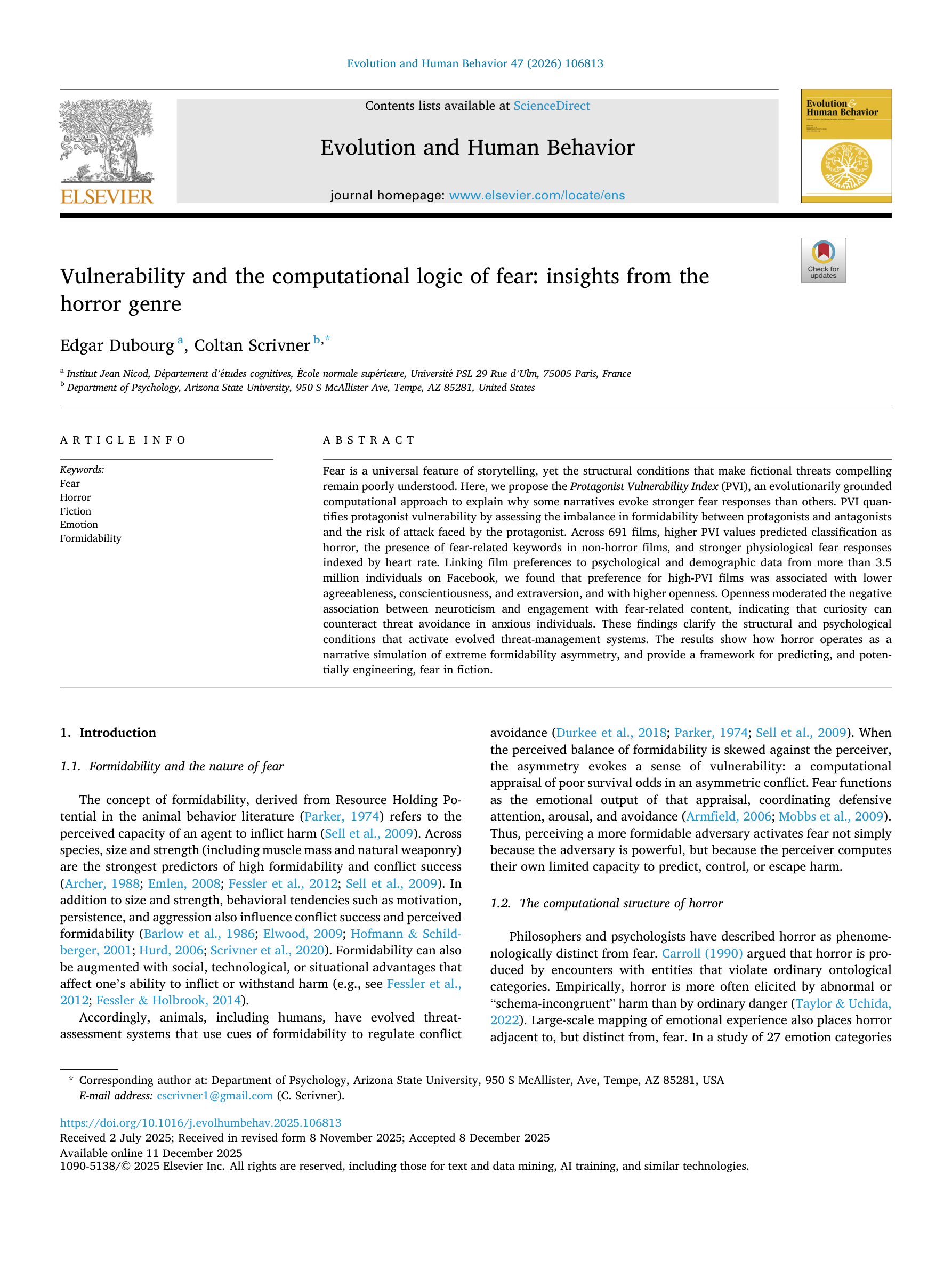
Vulnerability and the computational logic of fear: Insights from the horror genre
Dubourg, E., Scrivner, C.
Evolution and Human Behavior · 2026
12
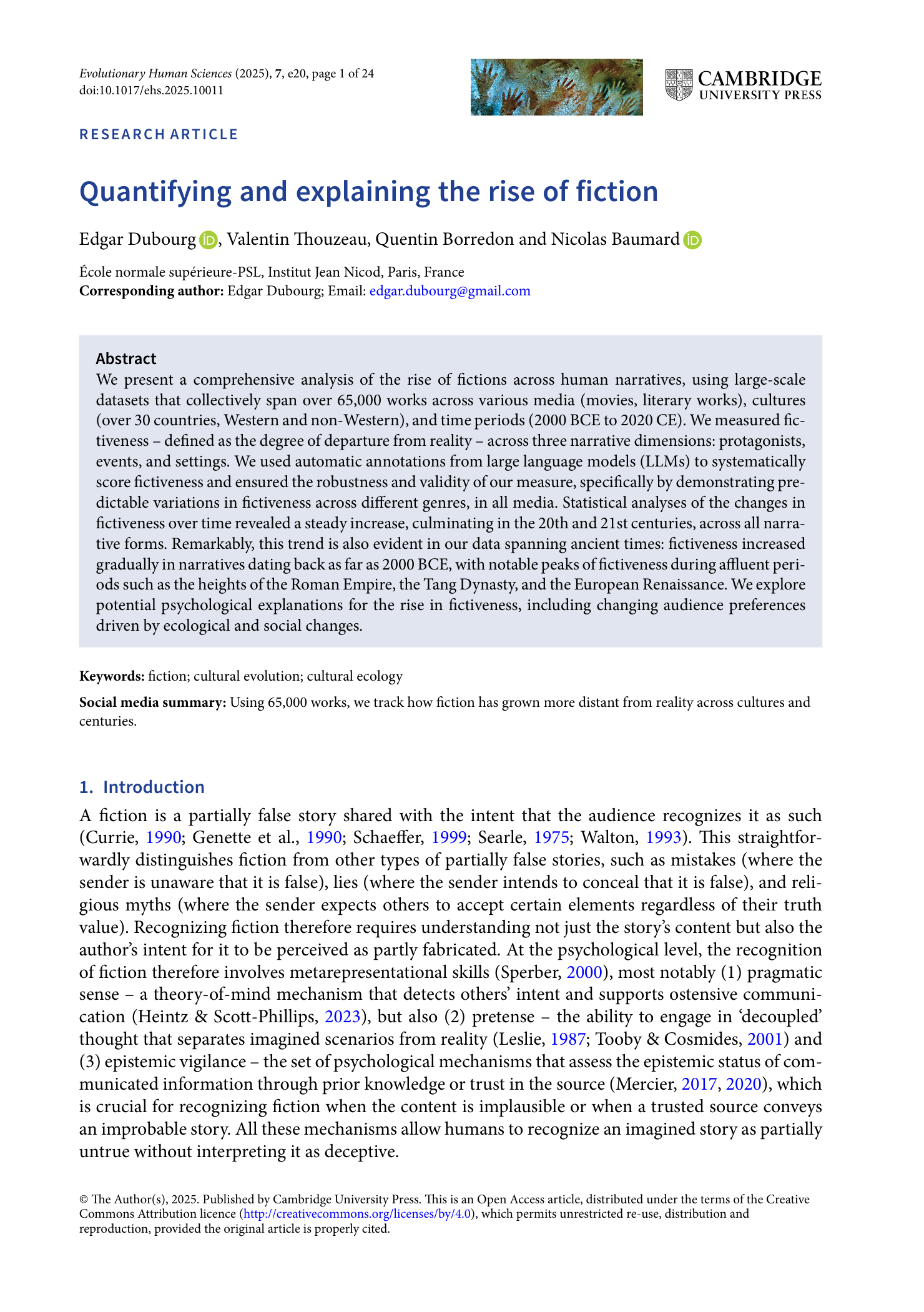
Quantifying and explaining the rise of fiction
Dubourg, E., Thouzeau, V., Borredon, Q., Baumard, N.
Evolutionary Human Sciences · 2025
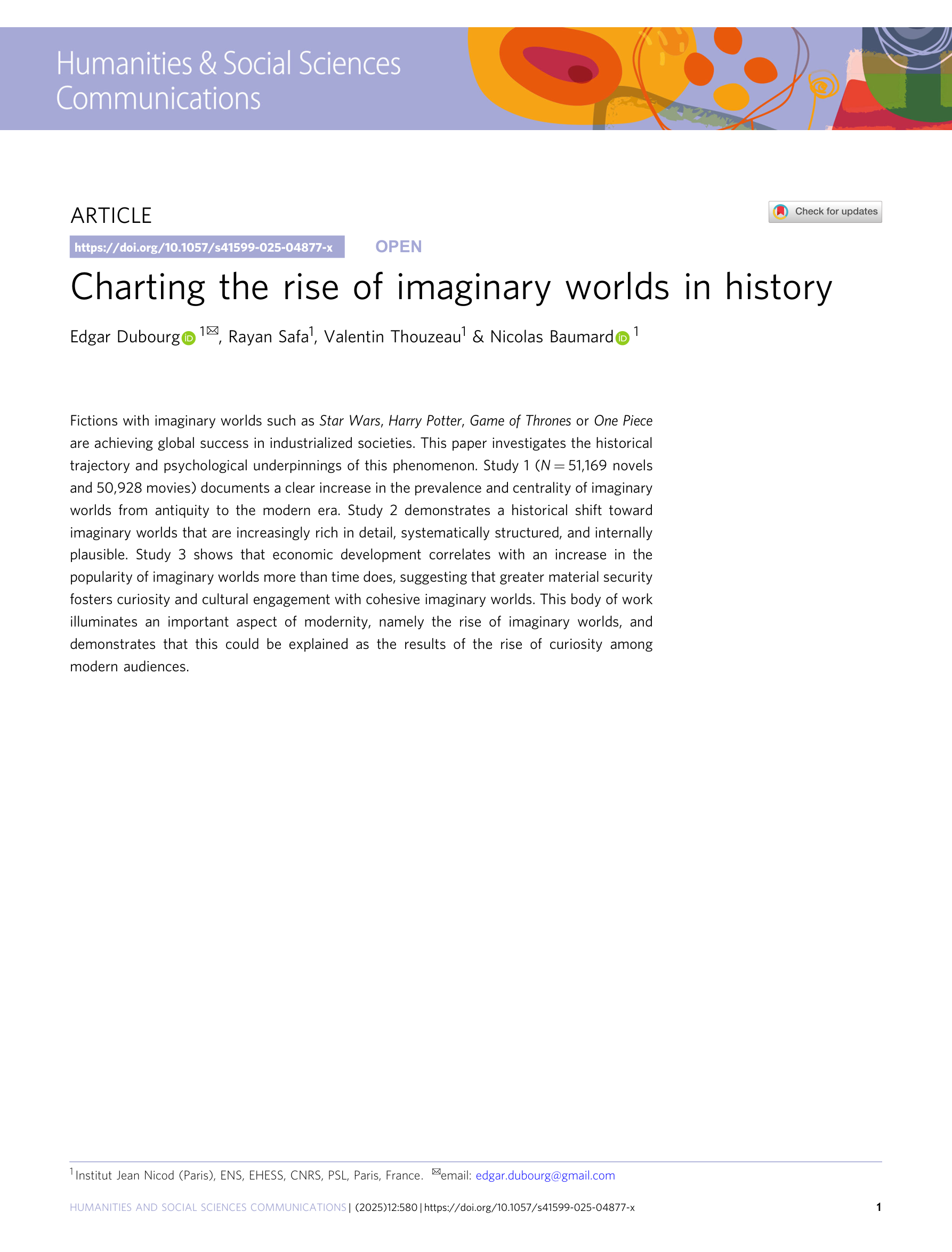
11
Charting the rise of imaginary worlds in history
Dubourg, E., Safa, R., Thouzeau, V., Baumard, N.
Humanities and Social Sciences Communications · 2025
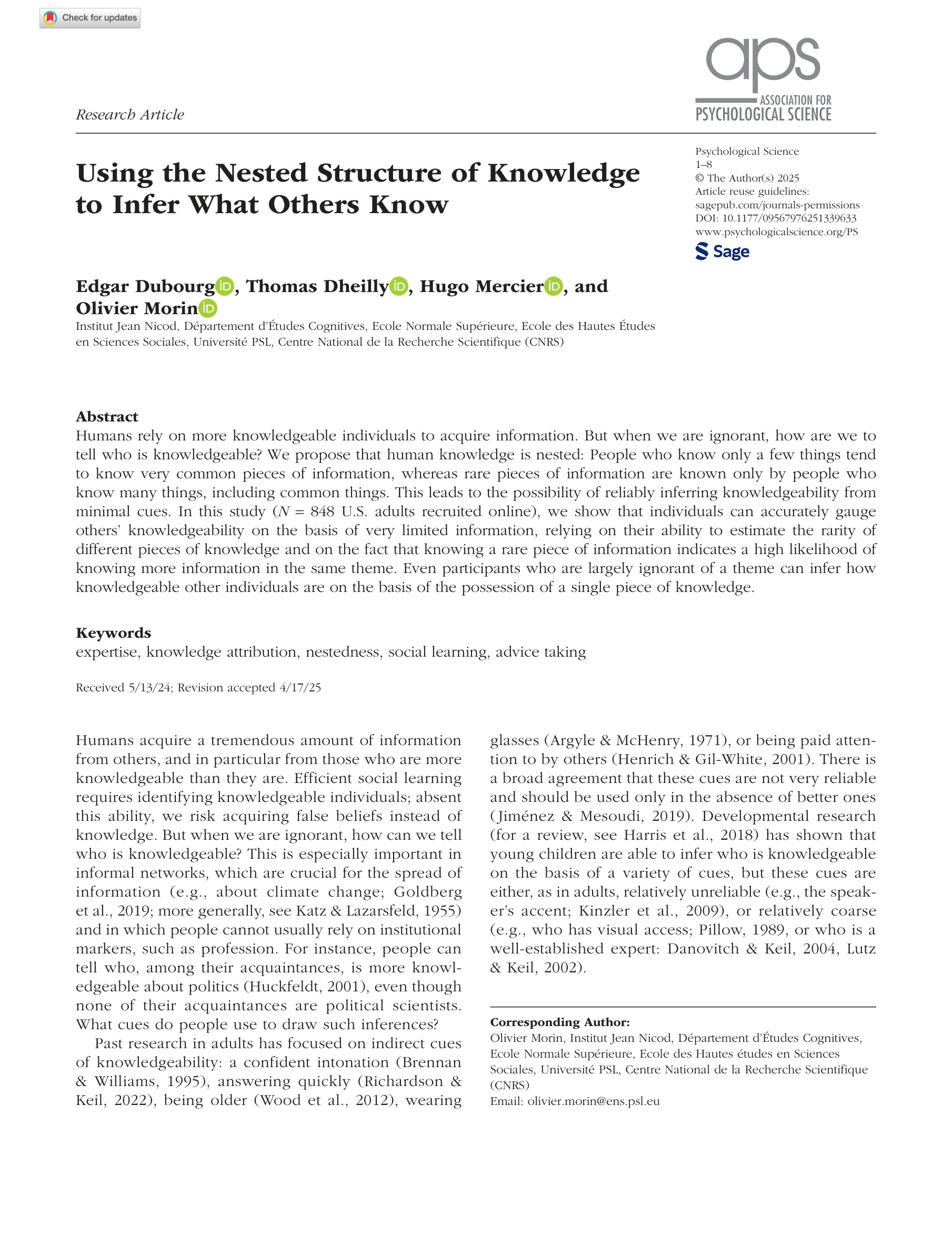
10
People use the nested structure of knowledge to infer what others know
Dubourg, E., Dheilly, T., Morin, O.†, Mercier, H.†
Psychological Science · 2025
9
Insight-seeking is consistent across domains and distinct from other forms of curiosity
Mercier, M., Dubourg, E., Mercier, H.
Personality and Individual Differences · 2025
8
Did teddy bears culturally evolve to be cuter? A preregistered replication
Borredon, Q.*, Bulamac, Z.*, (…), Morin, O.†, Dubourg, E.
Journal of Cognition and Culture · 2025
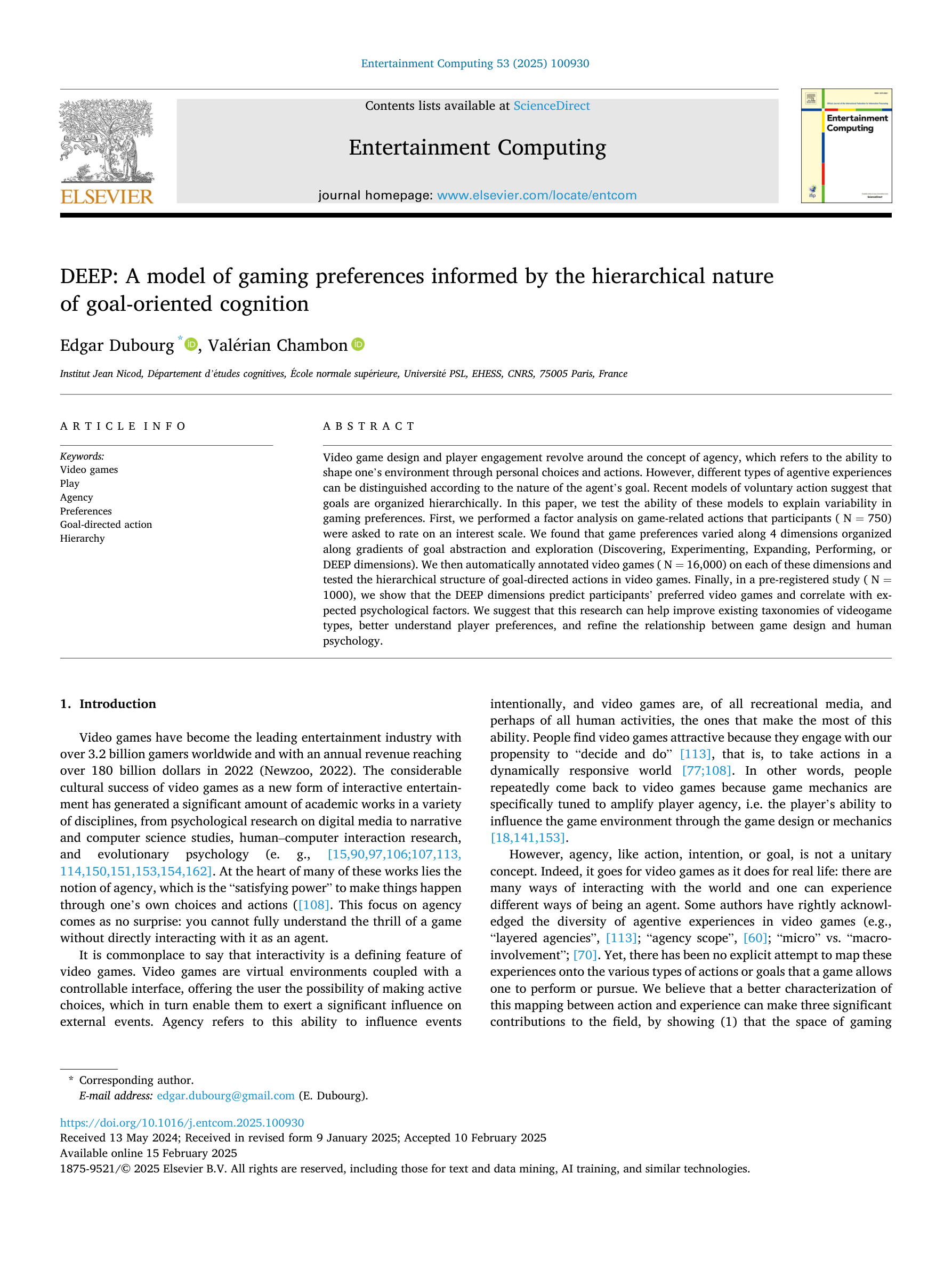
7
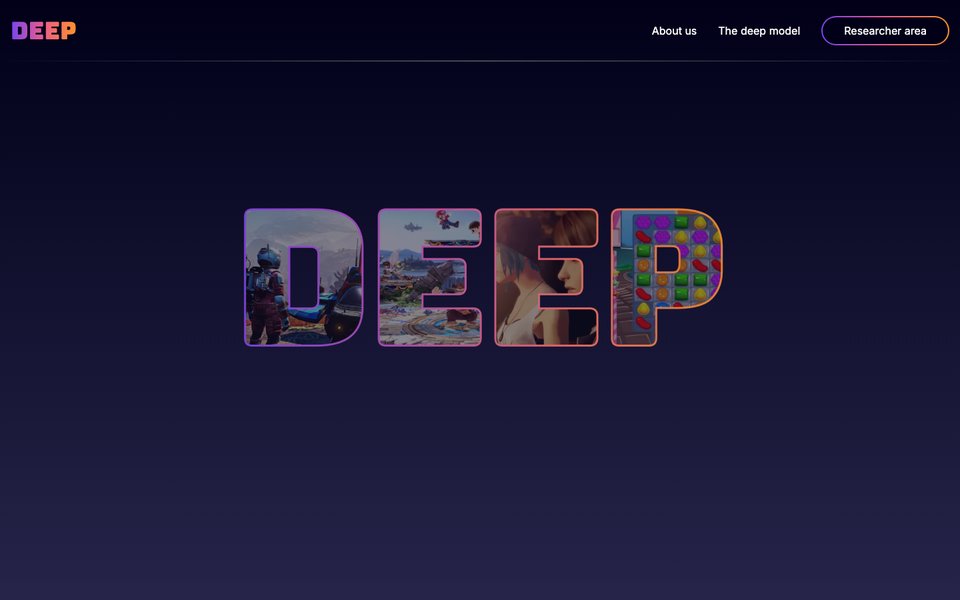
DEEP: A model of gaming preferences informed by the hierarchical nature of goal-oriented cognition
Dubourg, E., Chambon, V.
Entertainment Computing · 2025
6
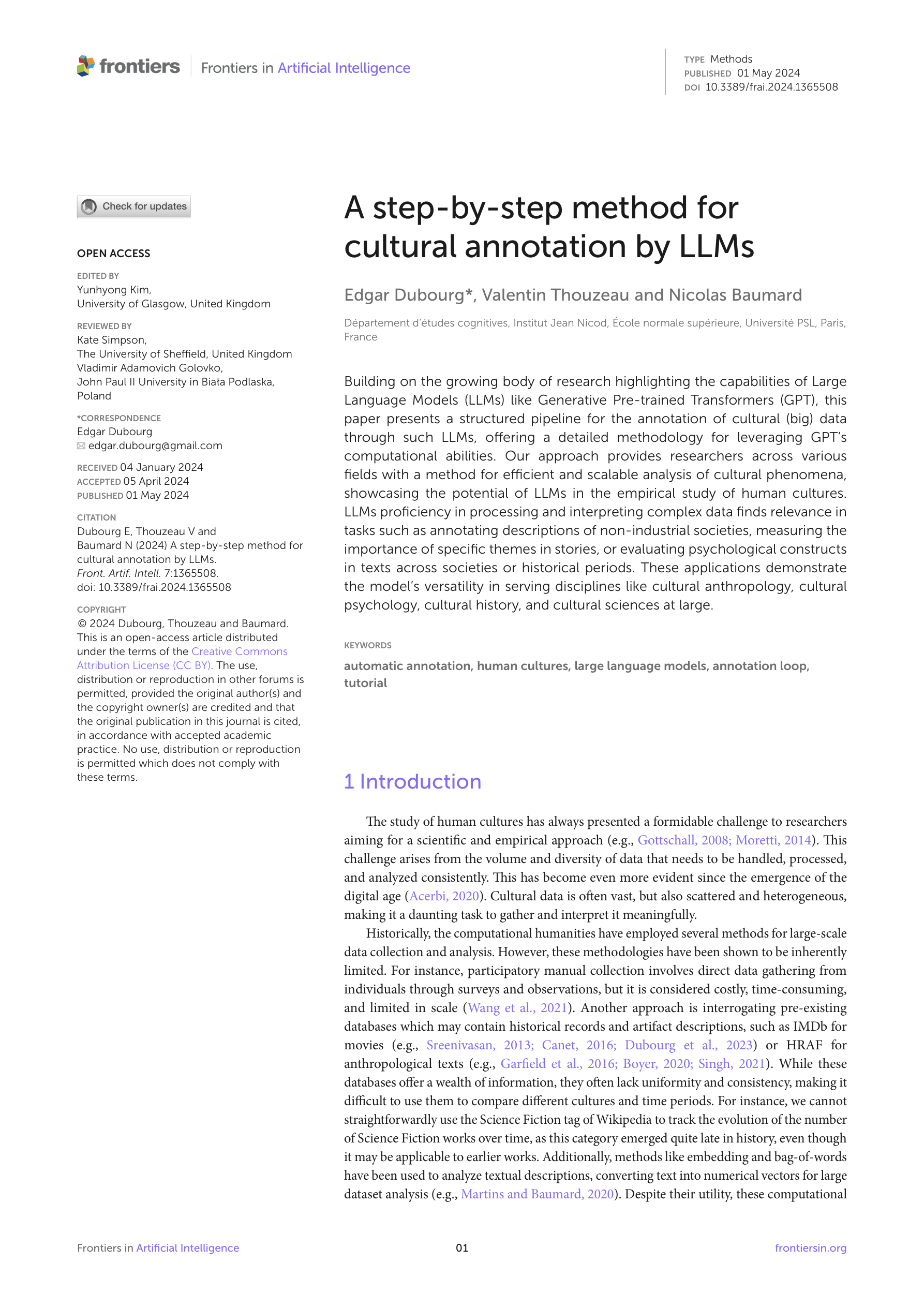
A Step-By-Step Method for Cultural Annotation by LLMs
Dubourg, E., Thouzeau, V., Baumard, N.
Frontiers in Artificial Intelligence · 2024
5
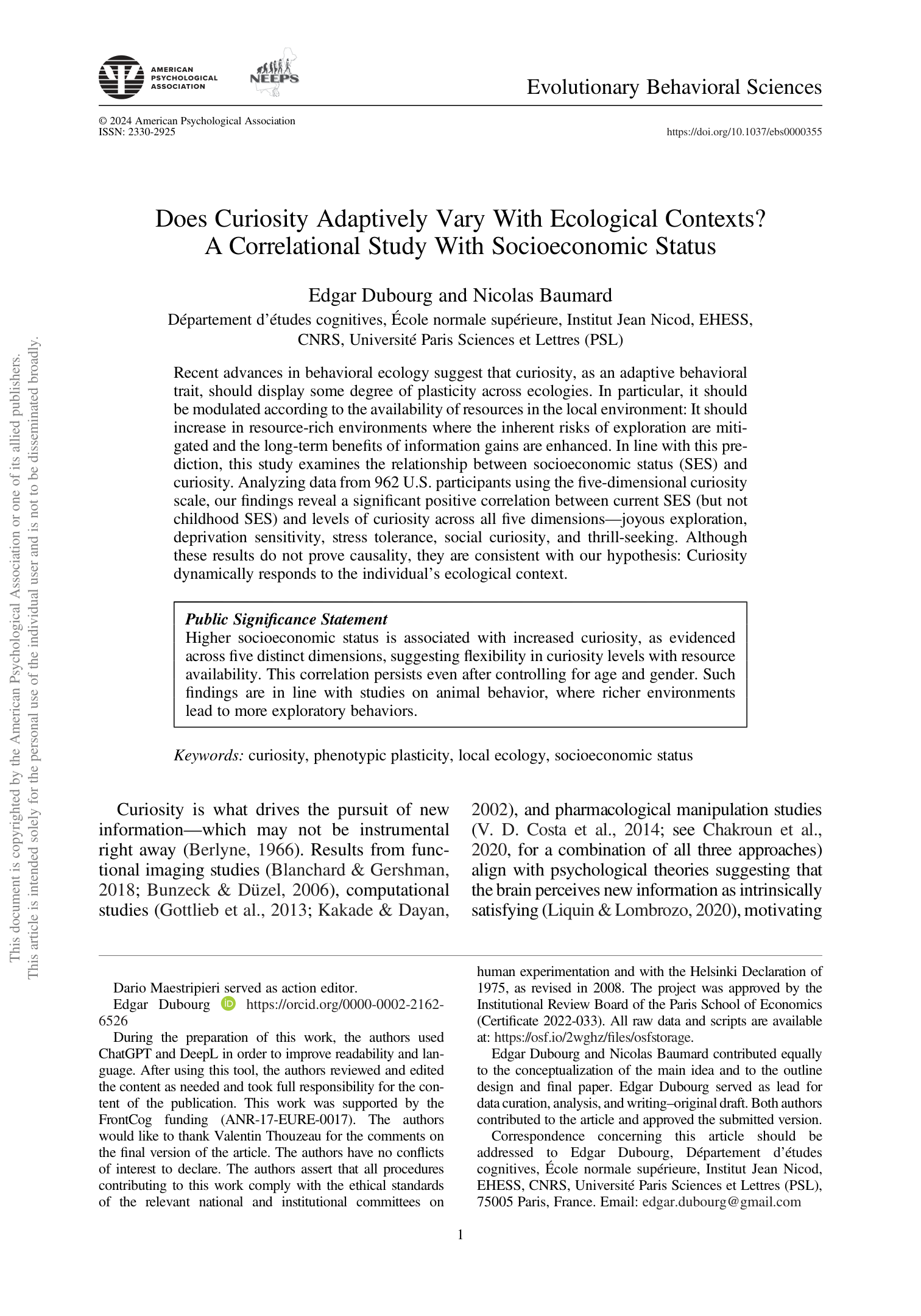
Does curiosity vary with ecological contexts? A correlational study with socio-economic status
Dubourg, E., Baumard, N.
Evolutionary Behavioral Sciences · 2024
4
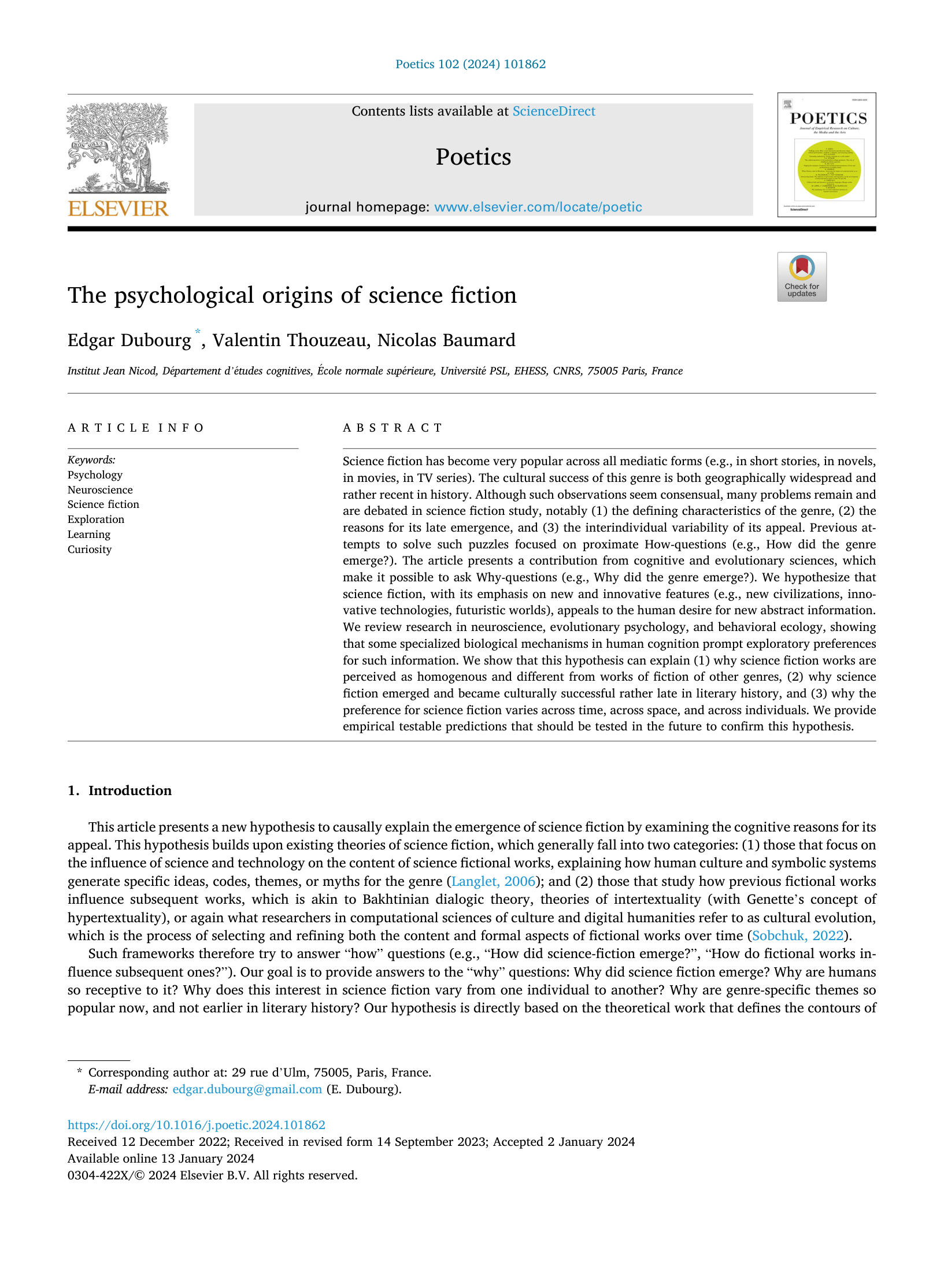
The psychological origins of science fiction
Dubourg, E., Thouzeau, V., Baumard, N.
Poetics · 2024
3
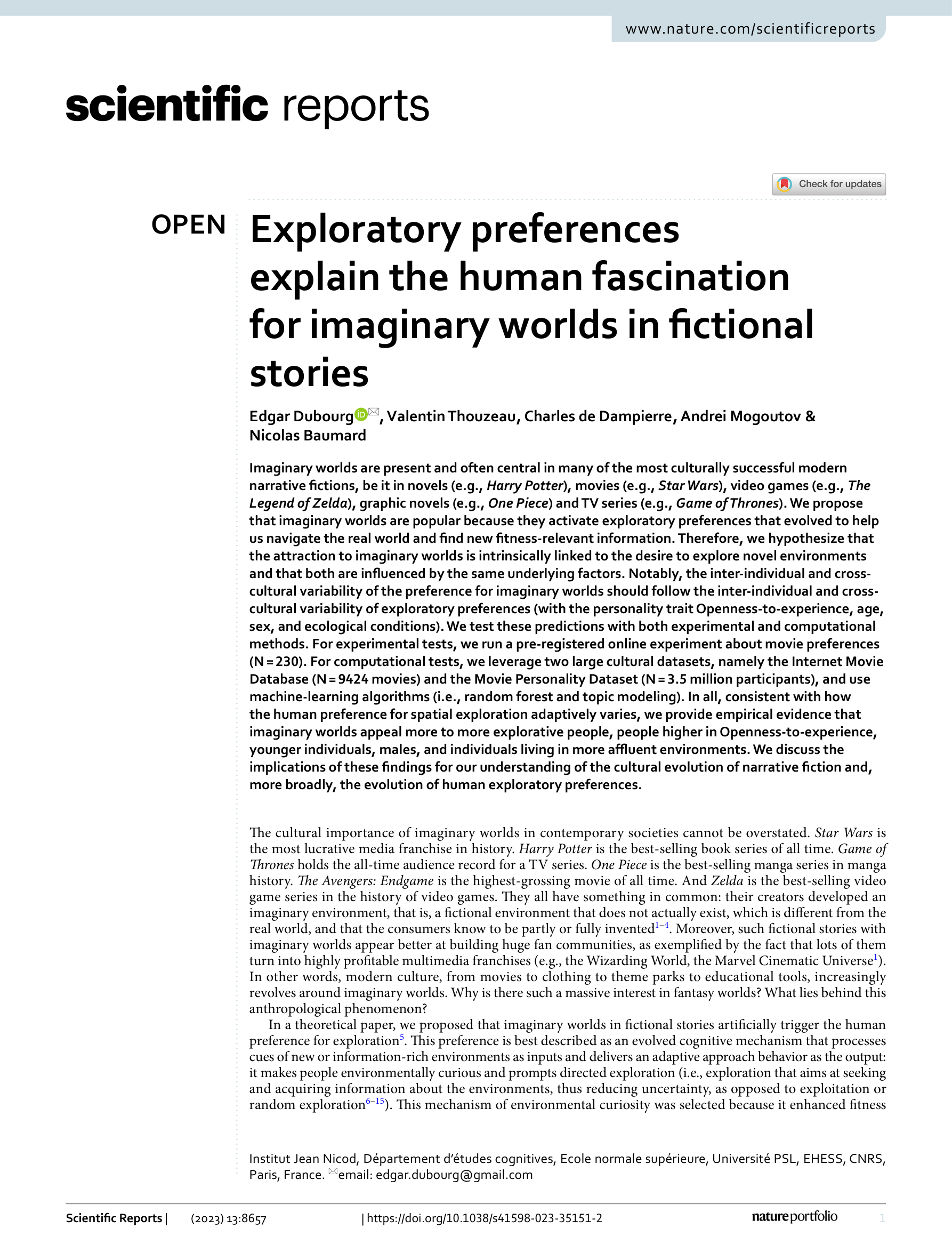
Exploratory preferences explain the human fascination for imaginary worlds in fictional stories
Dubourg, E., Thouzeau, V., de Dampierre, C., Mogoutov, A., Baumard, N.
Scientific Reports · 2023
2
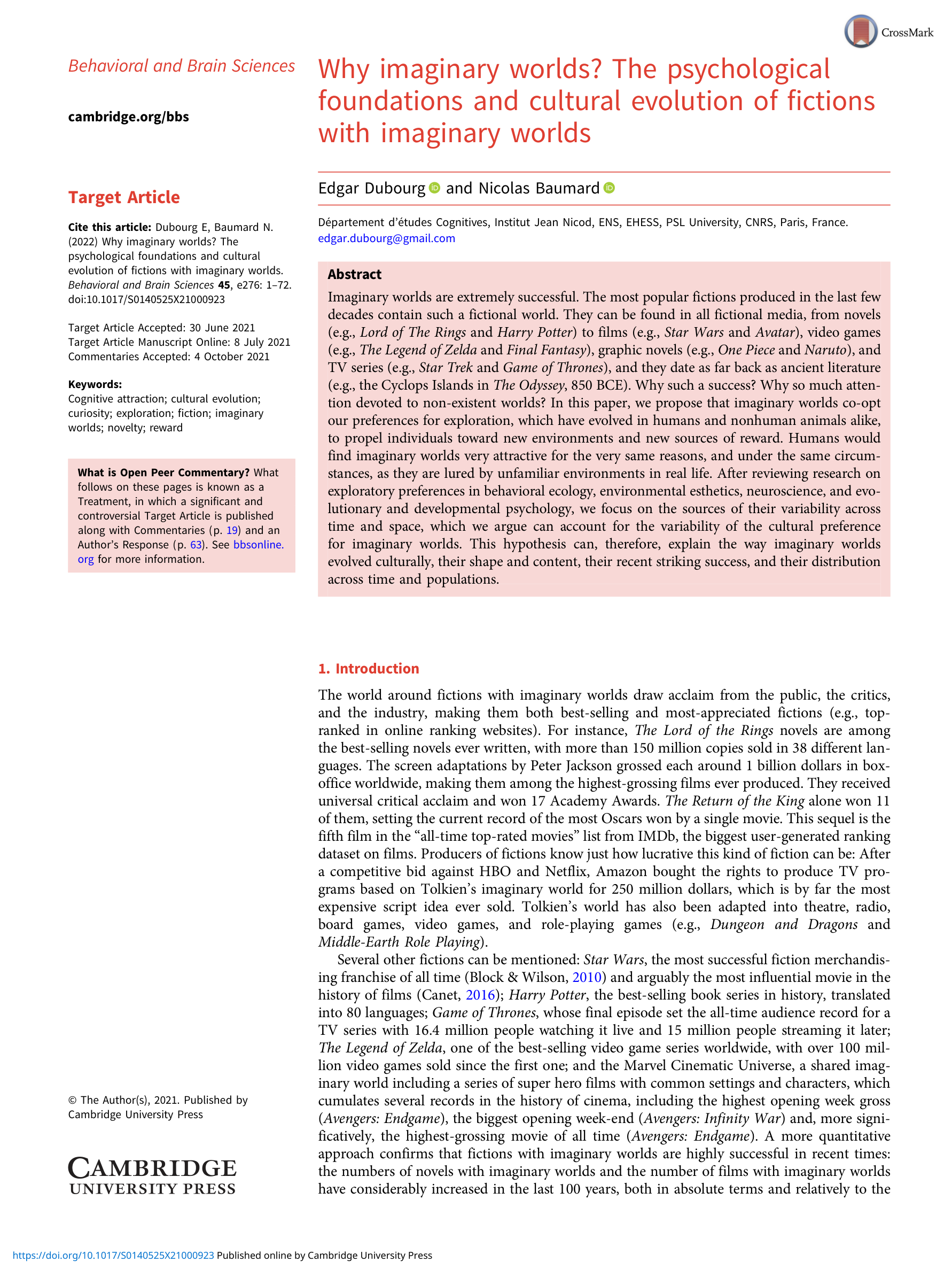
Why Imaginary Worlds? The psychological foundations and cultural evolution of fictions with imaginary worlds
Dubourg, E., Baumard, N.
Behavioral and Brain Sciences · 2022 · Target Article
1
Why and How Did Narrative Fictions Evolve? Fictions as Entertainment Technologies
Dubourg, E., Baumard, N.
Frontiers in Psychology · 2022

Commentaries

7
From attractors to ecological strategies: Embedding subjective selection in an evolutionary-ecological framework
Baumard, N., André, J.-B., Dubourg, E.
Behavioral and Brain Sciences · 2026 · Commentary on Singh (2025)
6
Distinguishing regulatory variables and ecological affordances
Dubourg, E., Baumard, N.
Behavioral and Brain Sciences · 2025 · Commentary on Ko & Neuberg (2025)
5
Human motivation is organized hierarchically, from proximal (means) to ultimate (ends)
Dubourg, E., Chambon, V., Baumard, N.
Behavioral and Brain Sciences · 2024 · Commentary on Murayama & Jach (2024)
4
Imaginary Worlds through the Evolutionary Lens
Dubourg, E., Baumard, N.
Behavioral and Brain Sciences · 2022 · Response to commentaries on Dubourg & Baumard (2022)
3
When instrumental inference hides behind seemingly arbitrary conventions
Dubourg, E.†, Fitouchi, L.†, Baumard, N.
Behavioral and Brain Sciences · 2022 · Commentary on Jagiello et al. (2022)
2
The Evolution of Music: One Trait, Many Ultimate-Level Explanations
Dubourg, E., André, J.-B., Baumard, N.
Behavioral and Brain Sciences · 2021 · Commentary on Mehr et al. & Savage et al. (2021)
1
Les mondes imaginaires dans les fictions
Dubourg, E.
Acta Fabula · 2021 · Commentary on Besson (2015)

Book Chapters & Proceedings

Is Cinema Becoming Less and Less Innovative With Time?
Dubourg, E., Mogoutov, A., Baumard, N.
Proceedings of Computational Humanities Research Conference · 2023
Do fictions impact beliefs? A critical view
Dubourg, E., Baumard, N.
Handbook of Fiction and Belief · 2023
L'origine des fictions : l'hypothèse des fonctions évolutionnaires sociales
Dubourg, E., André, J.-B., Baumard, N.
Fabula LhT · 2021
La Reconnaissance intuitive des fictions
Dubourg, E.
XXI-XX, Reconnaissance littéraire, Classique Garnier · 2020
La Conquête de la Fiction
Dubourg, E.
Romanesques, Classique Garnier · 2020

Presentations

Talks

Personality, Cognition, and Story Preferences Worldwide
French Society for Evolutionary Human Sciences · Montpellier, France · Nov 2025
Why Imaginary Worlds?
Human Behavior and Evolution Society (HBES) Conference · Aarhus, Denmark · May 2024
Is cinema becoming less and less innovative with time?
Computational Humanities Research (CHR) Conference · Paris, France · Dec 2023
The Cognitive Foundations of Fictional Stories: Further empirical developments
From Evolution to Cognition to Fiction Workshop · ENS-PSL, Paris, France · Jun 2023
Leveraging the hierarchical structure of goal-directed cognition to explain the variability of gaming preferences
Flash talk · Forum BrainPlay · Sorbonne Université, Paris, France · May 2023
Openness to experience: its evolutionary origin and its implication on symbolic culture
Department of Psychology, Royal Holloway, University of London, UK · Apr 2023
Cognitive mechanisms activated by fiction: A comprehensive framework
European Human Behavior and Evolution Association (EHBEA) Conference · University of London, UK · Apr 2023
Openness to experience: its evolutionary origin and its implication on symbolic culture
Flash talk · Evolution, Cognition & Culture workshop · Saint-Jacut, France · Dec 2022
A Comprehensive Framework to Study the Psychological Appeal for Narrative Fictions
Workshop "From Cultural Evolution to Computational Humanities" · Max Planck Institute for the Science of Human History, Jena, Germany · Jun 2022
Exploratory preferences explain the human fascination for imaginary worlds
Workshop "From Cultural Evolution to Computational Humanities" · Max Planck Institute for the Science of Human History, Jena, Germany · Jun 2022
The cultural evolution of non-existent worlds in fictions
ISFFS/SIRFF Second International Conference on Impossible Fictions · University of Chicago, online · Mar 2022
The cultural evolution of imaginary worlds
French Society for Evolutionary Human Sciences, Second annual meeting · Online · Nov 2021
The cultural evolution of imaginary worlds in fictions
Short talk · "Leda Cosmides and John Tooby: Honoring 40 years of innovation" · Royaumont, France · Sep 2021
The cultural evolution of imaginary worlds
Short talk · European Human Behavior and Evolution Association (EHBEA) Conference · Online · Mar 2021
Why Fiction? An evolutionary and cognitive approach
Workshop "Debating Fictions" · UNIL Lausanne & Sorbonne Nouvelle, Paris, France · Nov 2020
L'évolution culturelle de la comédie au cinéma
Colloquium "State of the art of comedy in France", Laboratoire LASLAR · Caen, France · Mar 2020

Posters

Cognitive mechanisms activated by fiction: A comprehensive framework
French Society for Evolutionary Human Sciences · Toulouse, France · Nov 2022
Experimental evidence suggests that exploratory preferences explain the cultural distribution of fictions with imaginary worlds
European Human Behavior and Evolution Association (EHBEA) Conference · Online · Apr 2022
Why Imaginary Worlds? Exploratory preferences explain the cultural success of fictions with imaginary worlds in modern societies
European Brain and Behaviour Society (EBBS) Conference · Online · Sep 2021
Why Imaginary Worlds?
Poster (Poster Award finalist) & Flash talk · Human Behavior and Evolution Society (HBES) Conference · Online · Jun 2021
Why Imaginary Worlds?
Culture Conference · Online · Jun 2021
Exploratory preferences explain the cultural success of fictions with imaginary worlds
European Human Behavior and Evolution Association (EHBEA) Conference · Online · Mar 2021

Invited Talks & Seminars

Stories and motivational preferences
Seminar of the Department of Cognitive Science · University of Neuchâtel, Switzerland · Oct 2025
A Step-By-Step Method for Cultural Annotation by LLMs
3-hour workshop, with V. Thouzeau · FRESH Conference · Paris, France · Nov 2023
The role of cognitive mechanisms in the cultural evolution of fictional stories
Early-career Social Learning Research Seminar Series · Online · May 2023
Imaginary worlds through the evolutionary lens
Workshop "Exploring the Mind's Canvas" · Learning Planet Institute, Paris, France · Feb 2023
What fictions do people like at different ages? Predictions from evolutionary developmental psychology
Cognitive Development Center Seminar · Central European University · Online · Mar 2022
Imaginary Worlds: An Ingredient for Fictional Recipes
Seminar of the Musée de l'Homme, with V. Thouzeau · Paris, France · Feb 2022
What lies behind the imagination of fictional worlds?
Seminar of the Imaginary & Morality Lab · Online · Dec 2021

Book

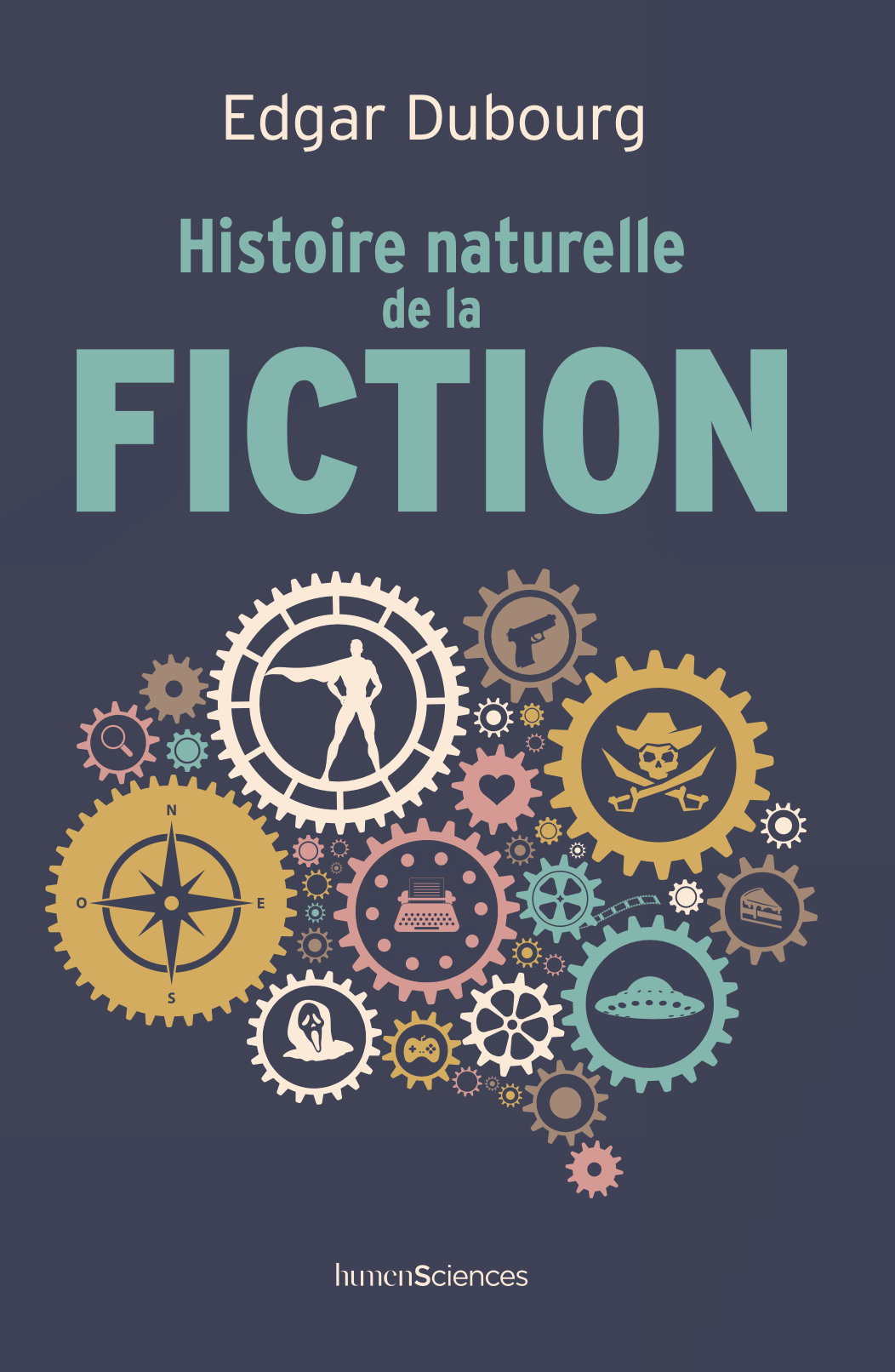
Histoire naturelle de la fiction

Why do humans invest so much emotion in stories that never happened? Drawing on evolutionary psychology and cognitive science, this book traces the deep origins of our fascination for fiction – from One Piece to Game of Thrones – and shows that these mechanisms emerged long before novels or cinema.

Published September 2025 · HumenSciences

Histoire naturelle de la fiction

Outreach

Press Coverage

Roger-Pol Droit · Le Monde des Livres · Sep 2025
Audrey Guiller · Ouest France · Jan 2024
Livia Dyring · Inspire the Mind · May 2023
Camille Gaubert · Sciences et Avenir · Apr 2023
Alexandra Pihen · Epsiloon · Feb 2023
Jon Gurutz Arranz · El País · Dec 2022
Lou Héliot · Le 1 des libraires · Nov 2022
Marius Mercier · Le Point · Sep 2021
TEDx Talk · Pourquoi sommes-nous fascinés par les fictions ?

Teaching

Guest Lectures

Student Supervision

T. Alabdeen Ali (2026), N. Noël (2026), M. Mirosavic (2026), P. Maunoir-Guérin (2025–26), E. Bidant (2025), R. Fraynet (2025), N. Ryszfeld (2024), R. Safa (2024), Q. Borredon (2023).

CV

2026–2029

AI Research Fellow

Paris School of AI, PSL · 3-year research fellowship

2025–2028

Postdoctoral Fellow

Institut Curie · Health Psychology & AI · PSL–Google · Sup.: V. Chambon

2020–2025

PhD in Cognitive Science

Institut Jean Nicod, ENS-PSL · Sup.: N. Baumard · Cognition Studentship

2017–2019

Master in Literary Theory & Philosophy

ENS-PSL · Highest honors

2012–2015

BA in Human & Social Sciences

Sciences Po Paris

Fundings

2026

Paris School of AI Fellowship

3-year research fellowship · ~120k €

2024

PSL–Google "AI for Societal Impact"

Post-doctoral grant · 160k € · Sup.: V. Chambon

2024

ANR Collaborative Research

Named collaborator · Measuring Agency in Gamified Interactive Contexts · 340k € · PI: V. Chambon, C. Chevallier

2020

Frontiers in Cognition Studentship

Fully funded 5-year PhD

Reviewing (selection)

Nature, Humanities & Social Sciences Communications, Behavioral & Brain Sciences, Evolutionary Human Sciences, Evolutionary Studies in Imaginary Culture, Review of Philosophy and Psychology, Personality and Individual Differences, Empirical Studies of the Arts, PLOS ONE, American Journal of Psychology, Poetics, Evolutionary Behavioral Sciences.

Contact